By Weisberg Cummings, P.C. on December 30th, 2025
How to Know When Your Employer’s Parental Leave Policies Are Unfair
Bringing a child home for the first time is a wonderful occasion. It’s a new beginning for your family and a time you should cherish.
But it’s also a time of change and often demands from your child. Whether you’ve just had a baby or you’ve adopted or fostered a child, it can take time for you and your child to adjust to your new life. That’s why parental leave is so important. All parents deserve time to focus on their family and make the best possible start to life with their child at home.
However, some employers’ parental leave policies are unfair and unwilling to grant this time. Here’s everything you need to know about your parental leave rights and how to know when your employer’s parental leave policies are unfair.
Understanding Parental Leave Laws
The Family and Medical Leave Act (FMLA) requires employers to allow all eligible employees to take unpaid leave to care for their newborn child at any point within one year of their birth. Employees who adopt or foster a child have the same rights — these employees can take their unpaid leave within one year of the child’s adoption or foster placement.
FMLA requires covered employers to protect the employee’s job while they take their leave. This protection means employees can return to their same position, or an equivalent position, once they return from their leave. Their group health coverage must also be unaffected and continue as if the employee had continued to work.
To qualify for 12 weeks of leave over the 12-month period, employees must:
- Work for a private organization that employs at least 50 workers within 75 miles of their working location.
- Work for that employer for at least 12 months, although this doesn’t have to be consecutive.
- Have at least 1,250 hours of service for that employer.
Unlike many other countries, the U.S. doesn’t have a federal paid parental leave policy. However, some states have their own laws on paid parental leave, and more have bills under consideration.
In Pennsylvania, the Family Leave Act was introduced in the state legislature in the spring of 2025, but it didn’t make it out of committee before the summer break. Workers employed by the state government are entitled to eight weeks of paid parental leave within six months of a qualifying event. These events include the birth of a child or the placement of a child for fostering or adoption.
Which Employers Qualify for FMLA Coverage?
FMLA coverage applies to employers that are either:
- A private organization with at least 50 employees.
- A government agency.
- A public or private elementary or secondary school.
What Other Parental Rights Laws Are There?
In addition to FMLA, the Pregnant Workers Fairness Act (PWFA) dictates that employers make reasonable accommodations for qualified employees and job applicants who have mental or physical conditions that are related to or arise from pregnancy. Conditions commonly accommodated for include vomiting, edema and placenta previa.
A reasonable accommodation changes the usual working environment or processes to allow the employee to perform their job as usual. Reasonable accommodations also allow the qualifying employee to access the same employment benefits as other employees.
Qualified employees must also be allowed to attend their healthcare appointments and to any needs that arise from their pregnancy. These can include:
- Using the bathroom frequently.
- Lifting restrictions.
- Avoiding extreme temperatures.
- Sitting or resting.
- Drinking water.
- Alleviating pain or risk in other ways.
These conditions can be mild or episodic and still qualify.
Signs of an Unfair Parental Leave Policy
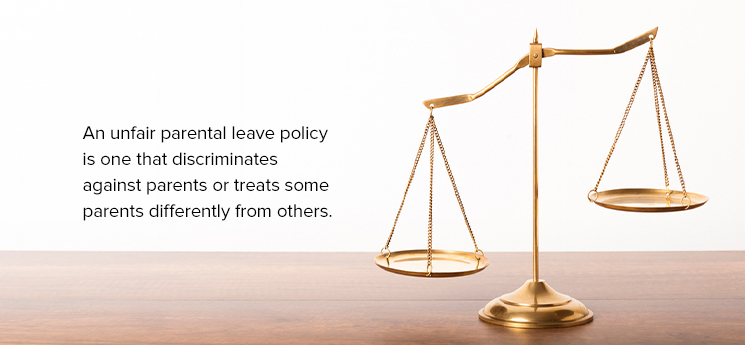
An unfair parental leave policy is one that discriminates against parents or treats some parents differently from others.
In the first case, this means any violation of your FMLA rights and any other parental rights you’re entitled to. In the latter case, this could be when your employers provide unequal leave for:
- Mothers and fathers: Beyond the mother’s typical recovery period of six to eight weeks, mothers and fathers should receive equal amounts of parental leave.
- Adoptive and biological parents: Parents who adopt are entitled to the same leave as biological parents.
- Different genders: Parental leave policies should be gender-neutral, with no bias toward which parent will be the primary caregiver.
Employer Actions That Violate Your Parental Rights
There are several ways your employer can violate your parental rights — these are some of the most common.
Denial of FMLA-Covered Leave
If you qualify for parental leave and provide the necessary information when you request your leave, it may be illegal for your employer to deny this.
Few employers will reject your leave request outright. Instead, they’ll find reasons why you don’t qualify for your leave, such as a lack of information or incorrectly filed paperwork. To ensure your employer can’t block your leave on these grounds, provide enough information for your employer to know that FMLA covers your leave request. You shouldn’t need to explicitly state that you wish to take FMLA-covered leave.
Retaliation for Taking Leave
Any discrimination or adverse action your employer takes against you as a result of your legally-protected leave is a violation of your rights. This action happens after you take or request FMLA leave, and could be:
- A demotion.
- A pay or other benefit cut.
- A disciplinary action.
- Being passed over for a promotion you deserved.
- An undesirable change in your responsibilities or role.
Lack of Job Security
When you return from your leave, you should be entitled to return to your position or an equivalent position. An equivalent position matches your skills and is virtually identical in responsibilities, pay and benefits.
If your employer fails to protect your job for you or tries to place you in a lower or ill-suited position, this is a failure to meet your rights.
Inadequate Accommodations
If your employer fails to make reasonable accommodations for your pregnancy, this could violate your PWFA rights. This violation could be something as simple as inadequate seating for you, or a lack of bathrooms, which means you can’t go as frequently as you need.
When they don’t make these accommodations, your employer is effectively discriminating against you, which could potentially pave the way to a lawsuit.
The Impact of Unfair Parental Leave Policies
Unfair parental leave policies, or failure to adhere to fair policies, can have a massive effect on both the employee and their workplace.
For the employee whose rights are violated, it can lead to emotional distress, financial strain and a damaged relationship with their employer. It can also add stress to what is often already a challenging time caring for a newborn or a recently placed child. This additional stress can have a long-term impact on the family’s well-being.
Other employees are also affected when they see how their co-worker’s rights have been violated. It can cause feelings of resentment and distrust toward their employer and create a poor working environment.
What to Do If You Suspect Your Policy Is Unfair
If you believe that your employer’s parental leave policy is unfair or in violation of your rights, the first step is to review their written policy. Often, an employee may have a fair policy but fail to adhere to it. In either case, if you find evidence that your parental rights are under threat by their policy or actions, you should discuss your concerns with your employer.
It’s important to document every instance of unfair treatment you experience or observe. You should also document every discussion you have with your employer about these concerns or anything related to your parental leave.
If your employer doesn’t take immediate action after you raise your concerns, you should consult an employment law attorney. They’ll clarify whether your employer’s policy is unfair, discuss your options with you and help you file a complaint with the Equal Employment Opportunity Commission or the Department of Labor’s Wage and Hour Division.