



Employees in the Harrisburg area and across Pennsylvania deserve to have a workplace environment that is safe and ethical. If you were fired, demoted or mistreated after reporting unsafe work conditions, you might have a workplace retaliation case. Employer retaliation is when employers unjustly punish workers for exercising their protected rights, which is illegal under state and federal law.
Weisberg Cummings is an employment law firm with experience handling employer retaliation cases. Speak with one of our knowledgeable lawyers to learn about your legal options for protecting your career.
Can You Sue a Company for Retaliation?
Yes, you may sue your employer for retaliation if you have valid legal grounds. You must assess the federal and state employment laws to determine whether you have a cause of action. A cause of action is the combination of facts that entitles you to a legal remedy. Determining whether you have a claim can be challenging, but an employment attorney can help.
Note that suing for retaliation in the workplace without a legal basis could be detrimental. Besides having the case dismissed, you may also incur financial losses through legal fees, court expenses, damages and costs. However, if you succeed, you may get monetary compensation and other kinds of relief.
What Are the Employer Retaliation Laws In Pennsylvania?
Several federal and state laws directly or indirectly prohibit employer retaliation in Pennsylvania. Examples include the following:
- Title VII of the Civil Rights Act (Title VII)
- Title I of the Americans with Disabilities Act (ADA)
- The Age Discrimination in Employment Act (ADEA)
- The Family Medical Leave Act (FMLA)
- The Pennsylvania Human Relations Act (PHRA)
- The Fair Labor Standards Act
The primary enforcement agencies are the United States Equal Employment Opportunity Commission (EEOC), Pennsylvania Human Relations Commission (PHRC), Department of Labor and OSHA.
Case law also plays a crucial role in employer retaliation in Pennsylvania. Case law is a body of laws or principles based on past judicial decisions that determine or influence subsequent cases. Understanding and applying these laws is technical, but the employment attorneys at Weisberg Cummings can use them to argue for your desired results.
What Counts as Employer Retaliation?
Employers can discipline or terminate workers for nonretaliatory and nondiscriminatory reasons. However, you may have an employer retaliation case if you are being retaliated against after exercising your legally protected rights. For example, workplace retaliation may happen after speaking out against:
- Sexual harassment: Sexual harassment includes coercion, inappropriate comments, sexually charged advances and other behaviors from another person that create an uncomfortable work environment.
- Unsafe working conditions: Unsafe working conditions occur when an employer breaks labor laws and safety codes, creating a dangerous environment for workers.
- Discrimination: Discrimination is unfair treatment due to a person’s religion, sexual orientation, age, ethnicity or other legally protected factors.
Good faith complaints of illegal harassment or discrimination are protected from retaliation whether you make the complaint on your own behalf or on behalf of a co-worker. Employers are also prohibited from retaliating against you for participating in an investigation of potentially illegal harassment or discrimination.
Consult with an employer retaliation lawyer if you have experienced any of the following:
- You reported unethical, unsafe or hostile workplace conditions to your employer and were treated negatively afterward.
- After reporting these conditions, you were demoted, denied work, assigned different tasks, given an unfavorable performance review or fired.
- Your employer made no changes to improve the workplace after you filed the complaint.
- Your employer holds you to different standards than others in your position.
Workplace retaliation cases can be difficult to prove since employers often deny retaliatory actions. If you have a viable case, the qualified employer retaliation attorneys at Weisberg Cummings will help you gather evidence, speak to witnesses and represent you in court to pursue justice for this unfair treatment.
How Much Is an Employer Retaliation Case Worth?
The worth of employer retaliation lawsuits or settlements varies based on several factors. For example, in litigation, the court may award different kinds of damages, which can affect your financial compensation. These include:
- General damages: This monetary compensation aims to place the winning party in a position they would have been but for the employer’s unlawful act. It is broad and may cover things like wage loss and pain and suffering.
- Punitive damages: These are intended to punish employers and are often awarded in egregious employer retaliation lawsuits. Examples include cases with elements of malice, fraud or oppression.
Other factors, like the severity of the case and how much you earn, can also impact the amount.
The same applies to settlements, except you negotiate the compensation based on the relevant considerations. It is also vital to take into account related costs like attorney fees and court expenses. The employment attorneys at Weisberg Cummings provide free consultation, which can help reduce the financial burden.
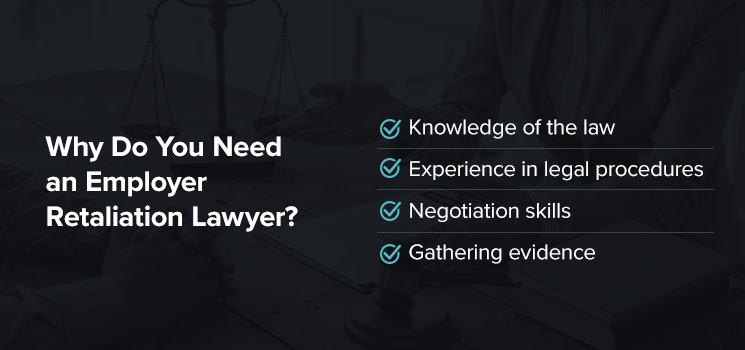
Why Do You Need an Employer Retaliation Lawyer?
Experiencing retaliation from an employer can be a distressing and complex situation, but a lawyer can help. Here are four reasons to partner with an attorney:
- Knowledge of the law: Employment attorneys can leverage their knowledge of the law to help you understand your rights and protect your interests.
- Experience in legal procedures: An attorney can assist you in navigating legal procedures such as filing a complaint with the EEOC or PHRC and representing you at trial.
- Negotiation skills: A skilled employment lawyer can negotiate on your behalf, aiming for a fair settlement to compensate you for your losses.
- Gathering evidence: Employment lawyers can help you collect and organize evidence of retaliation to support your claim, such as emails and witness statements.
Working with an experienced employment lawyer can increase your chances of success.
What Should You Consider When Choosing an Employer Retaliation Lawyer?
The employer retaliation lawyer you choose can impact your case. Here are a few things to consider:
- Experience: Select a lawyer with experience in employment law, particularly in retaliation cases. They should also know the Pennsylvania legal system.
- Reputation: Assess the lawyer’s track record to determine their reliability and effectiveness. You can check online reviews, testimonials and ratings from former clients.
- Approach to cases: A good lawyer should have a clear strategy for investigating your claims and pursuing your case. For example, they should help you understand why litigation or settlement is suitable.
- Fee structure: Lawyers have different fee structures. For instance, they may charge a flat fee, an hourly rate or a percentage of the damages recovered. Determine which structure is ideal and choose one with a flexible payment plan.
- Initial consultation: Some lawyers offer a free initial consultation. Use this opportunity to assess their suitability for your case and discuss your situation.
- Client relations: Learn how the lawyer treats clients. Are they friendly? Are they responsive? Do they express empathy and support? Employer retaliation cases can be stressful, but getting a caring lawyer can help.
Why Choose Weisberg Cummings?
Weisberg Cummings is ready to support you during your employer retaliation case. Our employer retaliation lawyers are familiar with the relevant laws and will help you determine if you have a case. If you decide to pursue legal action, we’ll devise the proper strategy for your unique situation.
Working with an employer retaliation lawyer can protect your career and may result in a settlement. Your employer retaliation case’s worth may differ, as settlements depend on many factors. We’ll also help you decide if your case is worth pursuing litigation.
Contact an employer retaliation lawyer: you did the right thing. we’ll protect you
Weisberg Cummings has over 40 years of combined experience helping people pursue justice after their hostile workplace has mistreated them. Our experienced lawyers can help you review your case against state and federal laws and pursue legal action if there is a case.
Schedule a free consultation with one of our employer retaliation lawyers today!
Retaliation and Whistleblowing FAQs
How do I Document Retaliation and Preserve Evidence?
You can document retaliation and preserve evidence with the following strategies:
- Organize a timeline that connects your protected activity to your employer’s retaliatory actions
- Keep a dated, detailed journal of retaliatory incidents that describes the retaliation you experience
- Save messages, emails and performance reviews
- Store documents related to the retaliatory incidents in a private space outside of work if possible
- Take screenshots of digital communications
- Gather witness statements
What Should I Do if HR or Management Starts Treating Me Differently After I Complain?
If your company’s HR personnel or management treats you poorly following a complaint, you should document everything, report the retaliation to your employer immediately, and consult with an employer retaliation attorney to understand your rights.
Follow your company’s reporting procedures, and avoid resigning as this can hinder your ability to claim wrongful termination. It’s also important to file a formal complaint with federal agencies such as the Equal Employment Opportunity Commission (EEOC) and OSHA.
Do I Have to Prove the Original Complaint Was Correct to Claim Retaliation?
No, you do not need to prove that your original claim was correct to claim employer retaliation. You need to prove that there is a direct link between your complaint and the employer’s adverse action. A complaint is a protected activity, whether it is correct or incorrect, so long as the complaint is considered a “good faith” complaint under the law. The important element is a causal connection between your action and your employer’s treatment of you following that action.
How Soon Should I File a Whistleblower Complaint After Retaliation?
You should file a whistleblower complaint as soon as possible following retaliation. Deadlines can vary between 30 and 180 days or more. Identify your state’s applicable statute of limitations for whistleblower complaints and file all required paperwork on time. The timeframe starts on the day you receive notification of the retaliatory action, such as demotion or termination.


