How Much Is My Criminal Record Discrimination Case Worth?
People with a criminal record may sometimes feel discriminated against in the workplace. While federal law allows employers the right to run background checks on potential employees, someone with a past criminal conviction might feel unfairly treated during the hiring process, even years after the situation has occurred.
Despite an individual showing growth and remorse for years after the event, the law generally gives employers a lot of say in the final decision to hire or promote someone with a criminal record. However, this does not mean that employers can discriminate in their hiring policies.
Unfortunately, finding a job can be difficult for someone with a criminal record, especially in a competitive market or industry.
What Is Criminal Record Discrimination?
Under the laws administered by the Equal Employment Opportunity Commission (EEOC), employers are prohibited from discriminating on the basis of protected classes, such as race, gender, religion or national origin. Regarding criminal record discrimination, employers cannot discriminate against applicants with similar criminal records based on protected classes. This is protected under Title VII of the Civil Rights Act of 1964.
Under federal law, employers in Pennsylvania can ask about your criminal history and request a background check during the hiring process. Some cities are passing legislation to remove this law from the hiring process, and some states will require employers to wait until later in the hiring process to ask about conviction records.
How Do I Know if I Have a Criminal Record Discrimination Case?
Under Pennsylvania’s Criminal History Record Information Act (CHRIA), employers may only screen job candidates for criminal records to help decide whether they will be a safe and reliable person to fill the position. If the conviction on your record does not affect your ability to be a reliable and safe employee at the job you have applied for, you may have a criminal record discrimination case.
When an employer requests an employee or potential employee’s criminal record from consumer reporting agencies (CRAs), they must follow the Fair Credit Reporting Act (FCRA), which also applies to existing employees who have applied for a promotion.
Under the FCRA, an employer must have written consent before running a background check. The report may include felony or misdemeanor convictions. Reporting or considering non-conviction information, such as summary offenses, pending charges or dismissed cases, is generally restricted by Pennsylvania state law and limited under federal law to events within the past seven years.
If you are unsure about whether you have been subject to criminal record discrimination, ask yourself the following questions:
- Were you asked for your permission for the employer to conduct a criminal history report?
- Did you receive a copy of the report before it was used to deny you a job or promotion?
- Were you sent a notice if a decision was made not to hire or promote you due to the CRA report?
- What relevance does your conviction have in relation to being a safe, reliable employee?
- Has your employer treated employees in similar situations differently?
- How much time has elapsed since your conviction?
The answers to these questions will help you determine if your situation could qualify as criminal record discrimination.
Criminal Record Discrimination Settlements
Due to the complex nature of each situation and scenario, there is no “one-size-fits-all” answer for what a settlement for a criminal record discrimination case might look like. Not all criminal record discrimination cases will go to litigation, and many will be resolved through a settlement.
This is mainly because most settlement amounts are usually not disclosed to the public. However, the following is a recent example of a criminal record discrimination case and its settlement amount in Philadelphia:
SEPTA Criminal Record Discrimination Settlement
After a years-long discrimination case that first began in 2016, SEPTA agreed to a $3.6 million settlement in January 2021. The settlement was first filed when a Philadelphia man applied for and was offered a bus driving position in 2014. The job offer was later revoked when drug-related convictions from 1997 were found as part of his background check. The charges were considered irrelevant to the position, given the length of time that had passed and the nonviolent nature of the charges.
Following the settlement, SEPTA agreed not to automatically prohibit employment based on any felony or misdemeanor conviction, unless a specific law requires exclusion for that office.
Filing for Damages
Under the Pennsylvania state law, the CHRIA permits a person to file for damages caused by facing discrimination due to their past criminal record. The employer can be held responsible for no less than $100 for each violation for all actual and real damages.
For discrimination claims under Title VII, employers may also be held liable for:
Punitive Damage
If the action is found to be willful, an employer can be held accountable for punitive damage. The amount of compensatory and punitive damages recovered will usually depend on the size of the employer, but below is the current limit based on the employer’s company size:
- A $50,000 limit for employers with 15-100 employees
- A $100,000 limit for employers with 101-200 employees
- A $200,000 limit for employers with 201-500 employees
- A $300,000 limit for employers with over 500 employees
Attorney’s Fees and Other Costs
If your criminal record discrimination case is in violation of Title VII of the Civil Rights Act of 1964 or the CHRIA, you are typically awarded attorney’s costs if your case is successful or ends in a settlement.
If you have lost your job because of criminal record discrimination and feel entitled to a wrongful termination case, you may also be awarded further damages via medical expenses, lost benefits and earnings and job search costs.
How Much Is a Criminal Record Discrimination Case Worth?
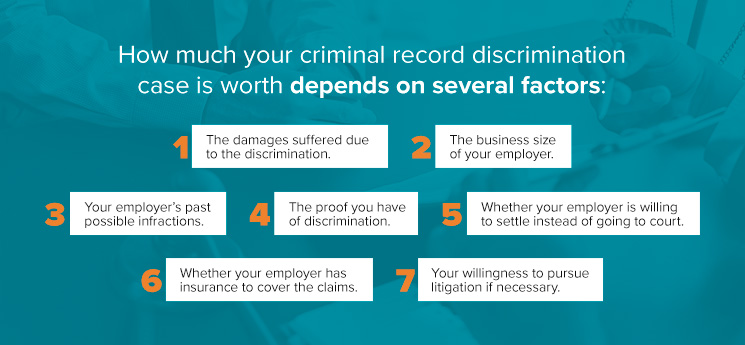
The worth of criminal record discrimination cases will vary on a case-by-case basis. How much your criminal record discrimination case is worth depends on several factors, including:
- The damages suffered due to the discrimination.
- The business size of your employer.
- Your employer’s past possible infractions.
- The proof you have of discrimination.
- Whether your employer is willing to settle instead of going to court.
- Whether your employer has insurance to cover the claims.
- Your willingness to pursue litigation if necessary.
Fair Chance Ordinance Amendments 2025
The Fair Chance Ordinance, also known as the “ban the box” ordinance, has been in place since 2011. The 2025 amendments introduced a new ordinance that was unanimously passed by the Philadelphia City Council and will go into effect on January 6, 2026.
Some key amendments for employees and employers to be aware of are:
- The term “employment” will also cover independent contractors and freelancers who are temporarily employed by the employer. Employers must comply with the same standards for these people as they do for full-time workers.
- Employers can only consider felony convictions if the arrest or release happened within the last seven years and misdemeanors within four years. Summary offenses can still not be considered.
- Employers are required to show that a criminal conviction poses a job-related risk. All hiring and promotional decisions need to account for training, education and rehabilitation licensure.
- Employers must issue a written notice of the convictions considered, reiterate the applicant’s rights and give the employee 10 business days to respond before they are rejected for an application due to their criminal history.
- Compensatory damages may reach up to $2,000 per violation, not including attorney fees and other damages awarded, depending on the orders of the Philadelphia Commission on Human Relations.
Steps to Take if You Suspect Discrimination
If you feel that you are experiencing criminal record discrimination at work, take the steps below to make sure you are keeping track of when and where these instances occur:
- Keep a diary of specific instances where you’ve felt discriminated against, including dates, times and the people involved.
- Save and bookmark any emails, messages or screenshots where you feel you’ve encountered discrimination.
- Be open and honest about your feelings with your employer and attempt to resolve the issue respectfully.
- Maintain professionalism and respect when discussing the matter, even if you feel that you have not received the same.
- Contact an experienced employment law attorney to ensure your case receives the care and focus it deserves.
Why Trust Us?
Our team at Weisberg Cummings, P.C. has decades of experience helping people navigate workplace discrimination cases. Located in Harrisburg, our firm works with clients throughout Pennsylvania. We can help you assess your unique situation, determine if you have a valid case and pursue legal action if necessary. We are well-versed in both local and federal workplace discrimination laws, so you can trust us to craft your case and defend your rights as an employee.
Schedule a Free Consultation With Weisberg Cummings, P.C.
Criminal record issues can be challenging to address alone. Having a dedicated criminal record discrimination attorney to support you will give you peace of mind. With assistance in gathering evidence, evaluating claims and upholding your legal rights, you can feel more secure about how to handle your potential workplace discrimination case.
At Weisberg Cummings, our professionals will draw on our 40+ years of combined legal expertise to support and advocate for you. Our supportive team can handle your complex discrimination issues and guide you in finding a solution. Contact us today to request your free consultation.