



What to Know About Wage Theft: Understanding Overtime and Your Rights
When you work 45, 50 or 60 hours a week, you expect your paycheck to reflect that time. Instead, you may be told you are “exempt,” be classified as an independent contractor, or receive the same hourly rate for every hour of overtime. At this point, you know something feels wrong, but you don’t have the legal language to explain why. Overtime misclassification can hide behind a job title, salary or contract that does not match the work you perform.
Here are key insights from Weisberg Cummings, P.C., on employer pay practices, overtime rules and your rights regarding potential wage theft.
Key Takeaways
Overtime eligibility depends on the law and the work you perform. Your employer’s chosen title does not settle the question, so keep these key points in mind:
- Under the FLSA and Pennsylvania Minimum Wage Act (PMWA), most employees who work over 40 hours a week are entitled to overtime at 1.5x their regular rate
- There are two primary forms of misclassification — exempt status misclassification and independent contractor misclassification
- Workers may be entitled to recover up to three years of back wages under Pennsylvania law
- Overtime misclassification may constitute wage theft under both federal and state law
- In FY 2025, the DOL recovered $146.3M in back wages specifically for overtime violations, covering 110,551 workers
- When a misclassification practice affects multiple workers, collective or class action claims may be an option
What Is Overtime Misclassification?
Overtime misclassification occurs when an employer incorrectly treats a worker as exempt from overtime or an independent contractor when the worker should receive employee protections.
Under the Fair Labor Standards Act (FLSA) and the PMWA, most covered employees who work over 40 hours a week must be paid at least 1.5 times their regular rate, known as time and a half. Pennsylvania’s Department of Labor & Industry confirms that this overtime generally applies to hours worked over 40, unless a specific exemption applies.
Misclassification can happen in several ways. An employer might give a worker a management title and assume that makes the position exempt. They might pay a salary and stop tracking the employee’s hours. In another case, the employer could issue a Form 1099 to classify the worker as an independent contractor, even though the employer controls the worker’s work in the way they would an employee’s.
How Does Overtime Misclassification Happen?
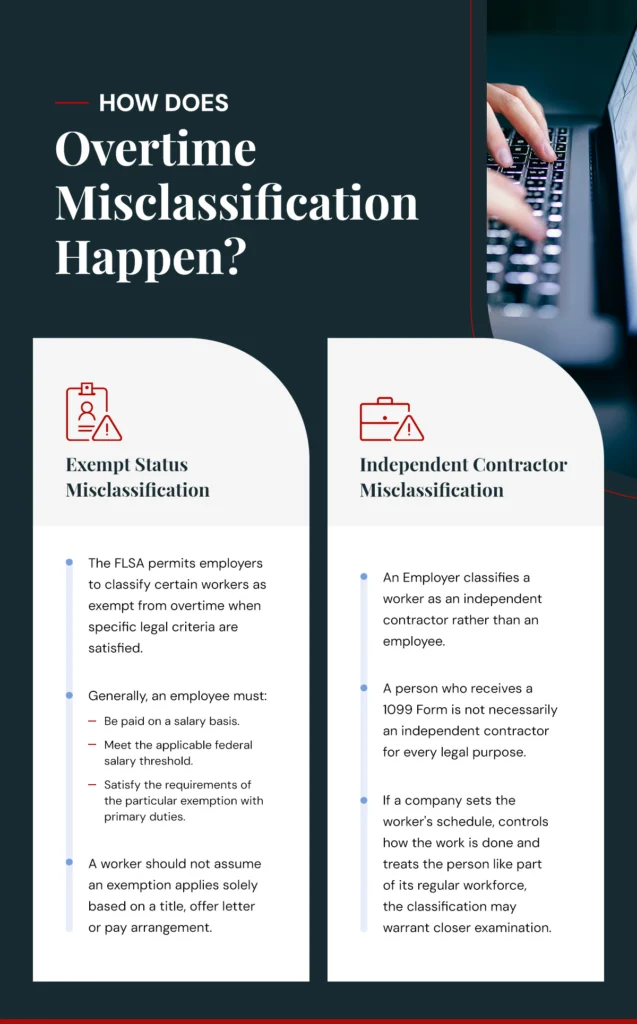
There are two ways overtime can be misclassified. An employer may incorrectly treat an employee as exempt from overtime or assign the employee the wrong classification.
Exempt Status Misclassification
The FLSA permits employers to classify certain workers as exempt from overtime when specific legal criteria are satisfied. Generally, an employee must:
- Be paid on a salary basis.
- Meet the applicable federal salary threshold.
- Satisfy the requirements of the particular exemption with primary duties.
The exemption depends on what the employee does each day. For example, calling someone a “manager” does not establish the executive exemption when that worker spends most of the workweek performing the same production-level tasks as nonexempt employees.
Similarly, an office worker does not become an exempt administrative employee because the employer changes their title to “administrator.” The applicable duties must be satisfied.
These rules can involve detailed factual and legal questions. A worker should not assume an exemption applies solely based on a title, offer letter or pay arrangement.
Independent Contractor Misclassification
Another form of overtime misclassification happens when an employer classifies a worker as an independent contractor rather than an employee.
Pennsylvania generally starts with the opposite presumption — a worker receiving wages for services is considered an employee unless the employer proves otherwise. Under Pennsylvania’s unemployment compensation law, the employer must establish both of these conditions to designate the worker a contractor:
- The worker has been and will continue to be free from the employer’s control or direction over the performance of services
- The worker is customarily engaged in an independently established trade, occupation, profession or business
A person who receives a 1099 Form is not necessarily an independent contractor for every legal purpose. If a company sets the worker’s schedule, controls how the work is done and treats the person like part of its regular workforce, the classification may warrant closer examination.
Construction workers, for example, face additional requirements under Pennsylvania’s Construction Workplace Misclassification Act. They must meet standard common-law rules and additional state criteria, which include maintaining a separate business location and carrying specific liability insurance.
How Pennsylvania and Federal Overtime Law Differ
Workers are covered by the FLSA at the federal level and the PMWA at the state level. The distinction between the two is that the systems are not identical. Pennsylvania law can offer protections that are more favorable to workers in certain circumstances. Important distinctions include:
- PMWA overtime compensation: Pennsylvania generally requires time-and-a-half for hours worked in excess of 40.
- Salary is not a substitute: Pennsylvania’s guidance stresses that salary, job duties and the applicable exemption requirements must all be considered.
- Different from state-law timing: Pennsylvania’s limitations rules may allow workers to pursue certain wage claims further back than federal FLSA claims, which generally have a two-year limitations period or a three-year period for willful violations.
The FLSA Duties Test
The FLSA’s white-collar exemptions are based on the employee’s primary duties. The key focus is on the work performed. A written job description can offer useful information, but it does not replace an analysis of real responsibilities. Pennsylvania likewise emphasizes actual duties rather than job titles.
The main categories include:
- Executive employees: Executive exemption generally focuses on management as the employee’s primary duty. They must satisfy requirements involving management, supervision and authority over personnel.
- Administrative employees: Administrative exemption generally applies to employees whose primary duty involves office or nonmanual work directly related to the employer’s business operations. Part of these duties includes exercising discretion or independent judgment on significant matters.
- Professional employees: Professional exemption generally covers certain learned professionals whose primary duties require advanced knowledge in a recognized field. These also include certain creative professionals whose work requires invention, imagination, originality or talent.
- Computer employees: Computer exemption applies to systems analysts, programmers, software engineers or highly skilled computer professionals. These duties include design, documentation, development, analysis and computer systems or program testing.
- Outside sales employees: Outside sales exemption applies to those whose primary duties involve obtaining orders and contracts or making sales. These individuals regularly work away from the business location and have no minimum salary requirement.
Salary Thresholds Under Federal and Pennsylvania Law
Meeting the duties test is only part of the analysis. For many white-collar exemptions, the employee must also satisfy a salary requirement.
The U.S. Department of Labor regulations require most employees covered by the executive, administrative or professional exemptions to receive at least $684 per week or a $35,568 annual salary. The highly compensated employee threshold is $107,432 per year, with at least $684 a week, paid on a fee or salary basis. This higher salary does not automatically create an exempt status. The applicable FLSA duties must also be satisfied.
When Overtime Misclassification Becomes Wage Theft
Overtime misclassification can become wage theft when an employer’s classification results in workers being denied wages they legally earned.
Pennsylvania’s Office of Attorney General expressly lists wage theft and misclassification as categories of fair-labor complaints. Its Labor Fraud Unit also identifies wage theft and misclassification among the labor violations it investigates.
The U.S. Department of Labor’s Wage and Hour Division reported recovering over $259 million in back wages for nearly 177,000 workers nationwide during the 2025 fiscal year — an average of $1,465 per individual. While these figures include different types of wage violations, they still show the scale at which unpaid wages can accumulate across the workforce.
What Workers May Be Owed When Misclassified
A worker who was incorrectly denied overtime may be entitled to several forms of recovery, depending on the claims and facts.
The starting point is usually the overtime that should have been paid. For example, if a nonexempt employee worked 50 hours in a week, the employee would generally be entitled to overtime for the 10 hours above 40.
Under the FLSA, qualifying workers may recover an additional amount equal to their unpaid overtime. Liquidated damages are generally designed to compensate workers for the loss caused by delayed payment, although the amount available may depend on the circumstances.
The FLSA provides for reasonable attorneys’ fees and litigation costs for successful claims. Pennsylvania’s wage laws can also provide for attorneys’ fees in appropriate cases. The Pennsylvania Superior Court has described attorney-fee recovery under Pennsylvania’s Wage Payment and Collection Law (WPCL) as mandatory for a prevailing employee in an action brought under that statute.
When Overtime Misclassification May Lead to Class Action Lawsuits
When employees face a common pay practice, the FLSA Section 216(b) may allow them to pursue claims collectively. Workers generally must affirmatively opt in by providing consent to join the federal collective. Pennsylvania cases regularly involve this type of FLSA collective claim alongside state-law claims.
A state-law class action is different. The PMWA claims may be pursued under traditional class-action procedures when the requirements for class certification are met.
Collective or class claims may allow workers with similar claims to address a shared pay practice in one proceeding. A company that denied one worker 10 hours of overtime may have denied those same hours to other workers, too. The size of a group claim does not guarantee certification or recovery. Courts examine the facts, the applicable legal standards and whether the workers’ claims are sufficiently connected.
Steps to Take If You Suspect Overtime Misclassification
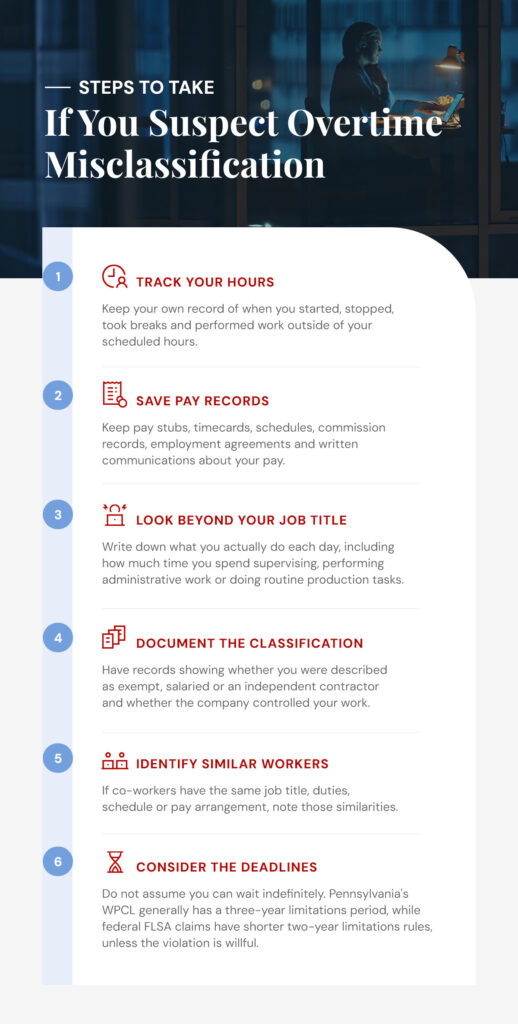
If your pay does not match the hours you work, preserve the information that may show what happened:
- Track your hours: Keep your own record of when you started, stopped, took breaks and performed work outside of your scheduled hours.
- Save pay records: Keep pay stubs, timecards, schedules, commission records, employment agreements and written communications about your pay.
- Look beyond your job title: Write down what you actually do each day, including how much time you spend supervising, performing administrative work or doing routine production tasks.
- Document the classification: Have records showing whether you were described as exempt, salaried or an independent contractor and whether the company controlled your work.
- Identify similar workers: If co-workers have the same job title, duties, schedule or pay arrangement, note those similarities. They may help establish whether the practice extended beyond one employee.
- Consider the deadlines: Do not assume you can wait indefinitely. Pennsylvania’s WPCL generally has a three-year limitations period, while federal FLSA claims have shorter two-year limitations rules, unless the violation is willful.
Frequently Asked Questions About Overtime Misclassification and Wage Theft
These common questions and answers can help clarify the difference between a payroll mistake, misclassification and a potential wage claim:
What is the difference between overtime misclassification and wage theft?
Overtime misclassification refers to the practice of denying overtime pay by incorrectly classifying an employee as exempt or an independent contractor. Wage theft is the broader concept of withholding wages to which an employee is legally entitled. In many cases, even if an employer pays by the hour, and pays overtime in certain circumstances, employers may refuse to pay for all hours worked. This may include time worked after an arbitrary “clock out” time, or time spent on the employer’s premises before or after a scheduled shift when an employee is required to log onto computer software, don required safety gear, wait in security check lines or walk significant distances through a plant to clock in.
When should I contact a wage theft attorney?
Consider speaking with an attorney when:
- You believe you have been denied overtime.
- The employer insists that your title makes you exempt.
- Even if you paid by the hour, your employer refuses to pay you for all hours worked or all hours you are required to be on the employer’s premises.
- You were treated as an independent contractor despite working like an employee.
- The same pay practice affected multiple workers.
It can also be useful to seek advice before signing a settlement, releasing wage claims, or accepting an employer’s explanation that you were not entitled to overtime. Wage claims can involve overlapping federal and Pennsylvania laws, and the applicable deadlines matter.
Can I file a wage claim if my employer says I’m an independent contractor?
Yes. An employer’s classification is not necessarily the final word.
Pennsylvania generally presumes a worker receiving wages for services is an employee unless the employer establishes that the worker is free from control or direction and is customarily engaged in an independently established trade, occupation, profession or business.
The facts surrounding the working relationship are important. A written “independent contractor” agreement may be relevant, but it does not automatically resolve every classification question.
Understanding Your Rights When Overtime Goes Unpaid
State and federal laws establish overtime protections for many workers, while exemptions only apply when their specific requirements are met. A job title, salary or 1099 form does not, by itself, settle the question.
When an employer misclassifies workers, the financial impact can extend far beyond one missed paycheck. Unpaid overtime can accumulate over months or years, and the same practice can affect an entire workforce. Consulting with a wage theft attorney can help identify the correct classification, the hours worked, the applicable law and relevant deadlines, and help to clarify a confusing pay dispute.

